About
Platform overview
As a comprehensive resource for control, the platform must organize vast amounts of knowledge. Many fields have wrestled with this problem, from library science and linguistics to computer science and machine learning. The main tool to do so, a knowledge organization system, is any scheme for organizing information with the purpose of retrieving data.
In contrast to most existing resources, the platform seeks to exploit the fact that information is highly connected. Instead of imposing a particular order on information a priori, the platform allows such an order to flow naturally from the interconnections between various concepts.
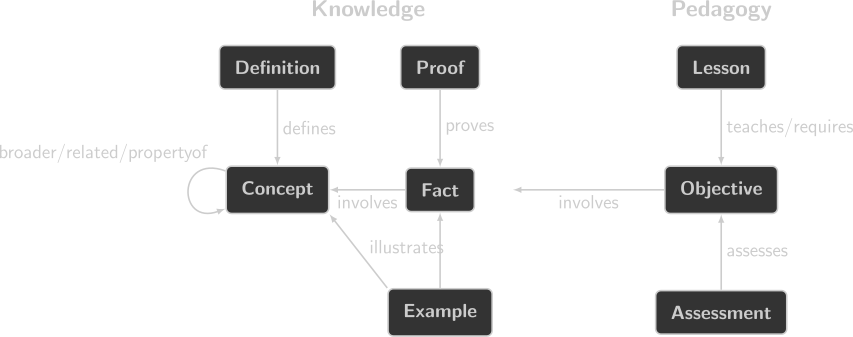
The following diagram illustrates the schema, which consists of object categories (boxes) and semantic relations (arrows). The structure is separated into knowledge and pedagogical layers, which are linked through learning objectives that involve knowledge objects (concepts, facts, definitions, proofs, and examples).

Gallery
As an online platform, we can use a variety of media formats to convey information. The following illustrates some features of the platform.
Diagrams
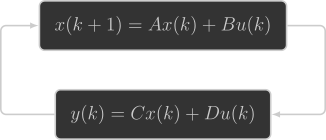
We can embed Tikz diagrams with the tikz shortcode. This allows for consistent styling for both light and dark themes.
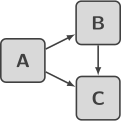
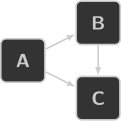
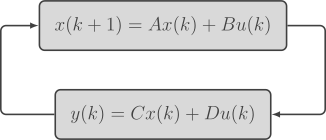
Diagrams are precompiled with pdflatex, so they can use any latex commands — including mathematics.
Circuits
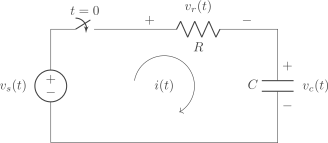
We can make circuit diagrams using circuitikz like this:
Mathematics
-
Inline math can be typed using
$...$but requires backslashes and underscores to be escaped.For example, $\|x\|_\infty$ is typed as
$\\|x\\|\_\\infty$. -
Display math can be typed using
\[ \begin{aligned} &\minimize && x^\tp P x \\ &\subjectto && \|x\| = 1 \end{aligned} \]\[...\]and does not require escaped backslashes, such asis typed using
\[ \begin{aligned} &\minimize && x^\tp P x \\ &\subjectto && \|x\| = 1 \end{aligned} \]